sf.

Publications

2026

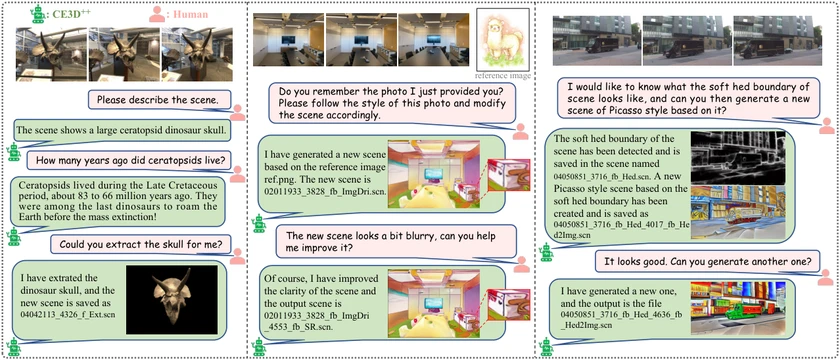
Chat-Edit-3D++: Interactive 3D and 4D Scene Editing via Large Language Models

Shuangkang Fang, Yufeng Wang, Yi-Hsuan Tsai, Wenrui Ding, Yi Yang, Shuchang Zhou, Ming-Hsuan Yang.

TPAMI · Accepted

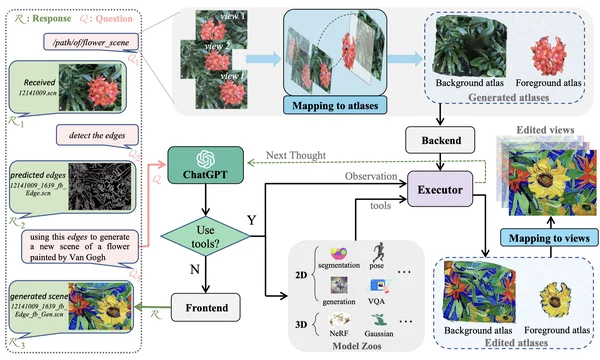
Chat-Edit-3D++ maps a scene onto 2D atlases so a language model can call image-editing tools over several rounds of conversation. Motion constraints extend the approach to moving objects in monocular video, while training on tool-use trajectories helps smaller models carry out multi-step edits.
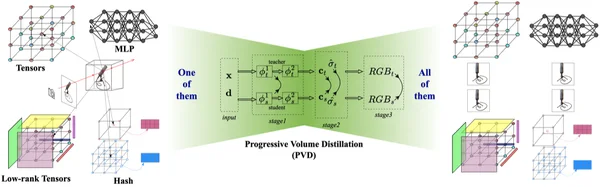
Editing 3D Scenes via Text Prompts without Retraining

Shuangkang Fang, Yufeng Wang, Yi-Hsuan Tsai, Yi Yang, Wenrui Ding, Shuchang Zhou, Ming-Hsuan Yang.

TVCG 2026

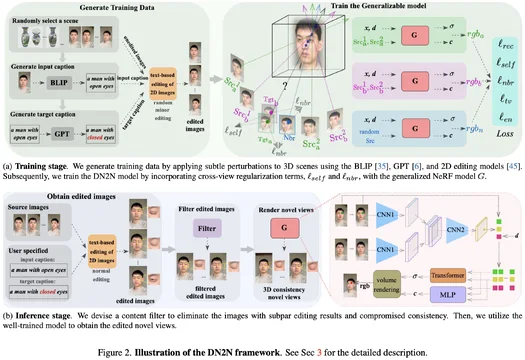
DN2N turns text-guided edits of individual images into a coherent 3D scene. It filters inconsistent views and trains a generalizable NeRF to handle the remaining variation, so a new scene or prompt can be edited without retraining.

Dropping Anchor and Spherical Harmonics for Sparse-view Gaussian Splatting

Shuangkang Fang, I-Chao Shen, Xuanyang Zhang, Zesheng Wang, Yufeng Wang, Wenrui Ding, Gang Yu, Takeo Igarashi.

CVPR 2026

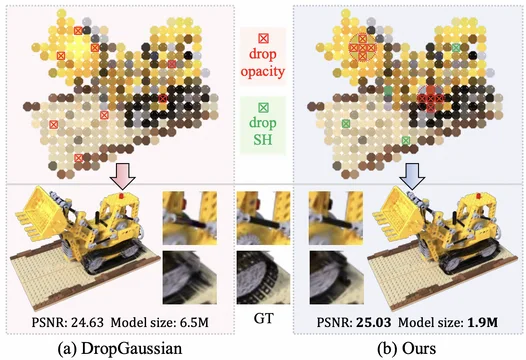
When training views are sparse, nearby Gaussians can compensate for a Gaussian dropped during training. DropAnSH-GS drops whole neighborhoods and selected high-order color coefficients, improving novel views and allowing the trained model to be compressed.

2025

MeshLLM: Empowering Large Language Models to Progressively Understand and Generate 3D Mesh

Shuangkang Fang, I-Chao Shen, Yufeng Wang, Yi-Hsuan Tsai, Yi Yang, Shuchang Zhou, Wenrui Ding, Takeo Igarashi, Ming-Hsuan Yang.

ICCV 2025 · Highlight

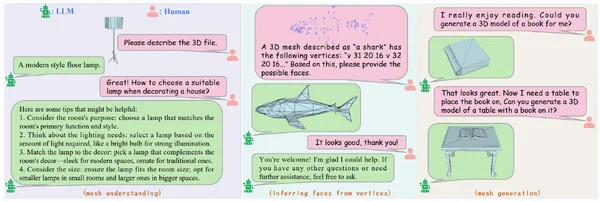
MeshLLM represents mesh vertices and faces as text so a language model can describe a shape or generate one in response to a prompt. Training it to infer faces from vertices and assemble local mesh parts helps it learn how surfaces fit together.

NeRF Is a Valuable Assistant for 3D Gaussian Splatting

Shuangkang Fang, I-Chao Shen, Takeo Igarashi, Yufeng Wang, ZeSheng Wang, Yi Yang, Wenrui Ding, Shuchang Zhou.

ICCV 2025

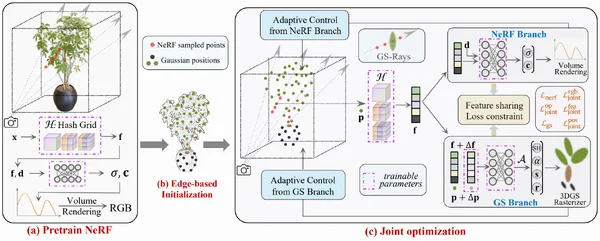
NeRF-GS fits a continuous radiance field and a set of Gaussians to the same scene. The radiance field guides Gaussian placement and shares spatial features across neighboring Gaussians, while learned offsets let individual splats capture local detail.

2024

Chat-Edit-3D: Interactive 3D Scene Editing via Text Prompts

Shuangkang Fang, Yufeng Wang, Yi-Hsuan Tsai, Yi Yang, Wenrui Ding, Shuchang Zhou, Ming-Hsuan Yang.

ECCV 2024

Chat-Edit-3D lets a user revise a scene over several turns of conversation. A language model selects visual tools to edit a shared 2D atlas, and the same edit is then visible from different camera positions.

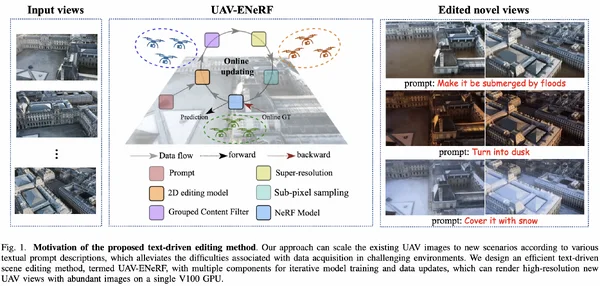
UAV-ENeRF: Text-driven UAV Scene Editing with Neural Radiance Fields

Yufeng Wang, Shuangkang Fang (equal contribution), Huayu Zhang, Hongguang Li, Zehao Zhang, Xianlin Zeng, Wenrui Ding.

TGRS 2024

UAV-ENeRF edits aerial scenes from text while accounting for the memory cost of high-resolution drone imagery. It edits sampled views at lower resolution, filters them for consistency with the prompt, and restores detail when rendering new views.

2023

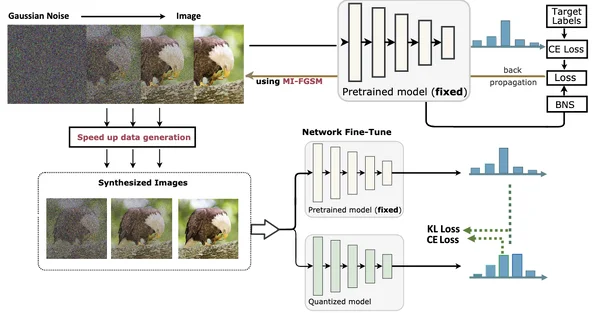
DFFG: Fast Gradient Iteration for Data-free Quantization

Huixing Leng, Shuangkang Fang (equal contribution), Yufeng Wang, Zehao Zhang, Dacheng Qi, Wenrui Ding.

BMVC 2023

DFFG quantizes a pretrained network when its original training data are unavailable. It synthesizes calibration inputs from the model’s batch-normalization statistics and reuses intermediate gradient updates to speed up data generation.